Published by:
CGP EDU Academic Team
Published on: September 12, 2026
In the figure shown, when the persons A and B exchange their positions, then
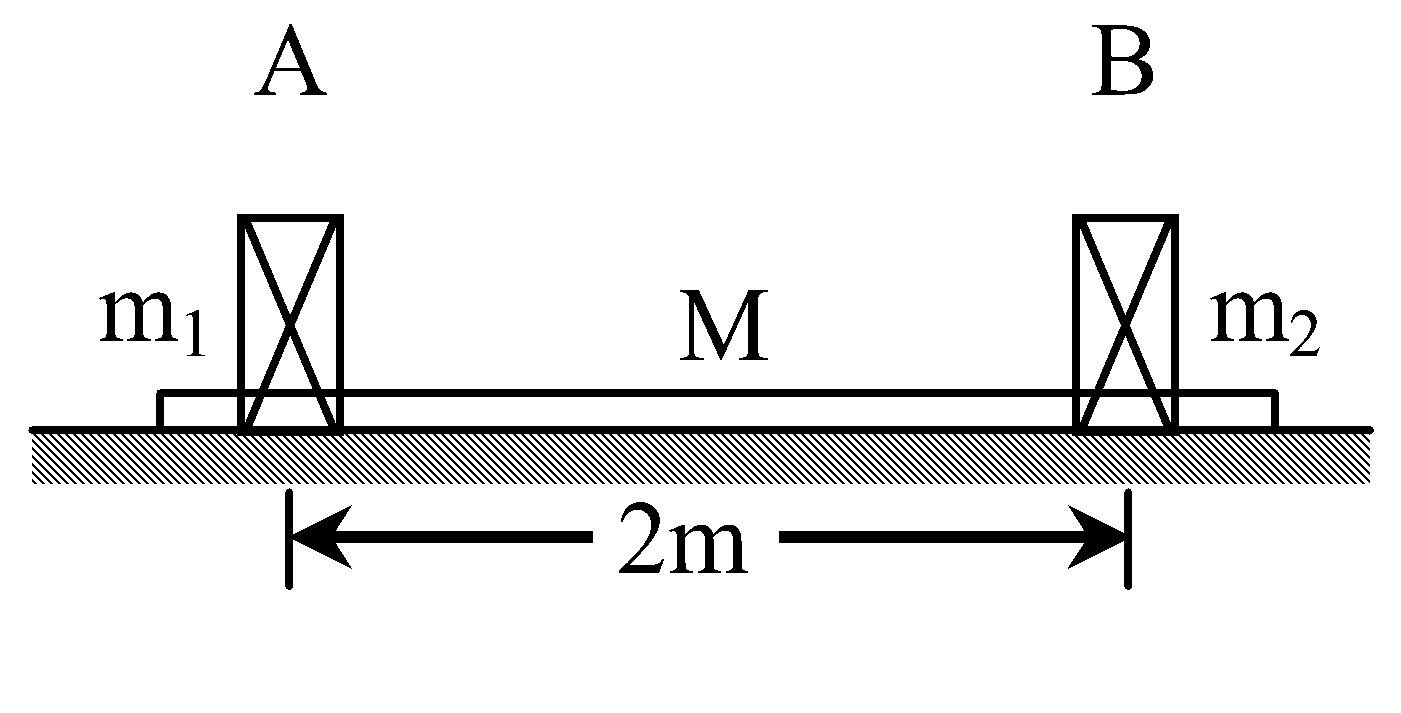
m 1 = 50 kg, m 2 = 70 kg, M = 80 kg
(i) The distance moved by the centre of mass of the system is ..................
(ii) The plank moves toward .................
(iii) The distance moved by the plank is ..........
(iv) The distance moved by A with respect to ground is ..................
(v) The distance moved by B with respect to ground is ................
Text Solution
Verified by ExpertsThe correct answer is:
A
Step 1: Define the initial and final positions of A and B.
Initial positions: A at 0 m (left) and B at 2 m (right).
After exchange, A moves to 2 m and B moves to 0 m.
Step 2: Calculate the center of mass (COM) before and after the exchange.
The total mass of the system is \( m_1 + m_2 + M = 50 + 70 + 80 = 200 \) kg.
Initial COM, \( x_{COM_i} = \frac{m_1 \cdot x_A + m_2 \cdot x_B + M \cdot x_{M}}{m_1 + m_2 + M} = \frac{50 \cdot 0 + 70 \cdot 2 + 80 \cdot 1}{200} = \frac{140 + 80}{200} = 1.1 \text{ m} \)
Final COM, \( x_{COM_f} = \frac{m_1 \cdot x_{A_f} + m_2 \cdot x_{B_f} + M \cdot x_M}{200} = \frac{50 \cdot 2 + 70 \cdot 0 + 80 \cdot 1}{200} = \frac{100 + 80}{200} = 0.9 \text{ m} \)
Therefore, the distance moved by the COM is \( |x_{COM_f} - x_{COM_i}| = |0.9 - 1.1| = 0.2 \text{ m} \).
Step 3: The plank moves towards B since it is lighter (having A at the heavier side).
Step 4: The distance moved by the plank is the same as the distance moved by the COM, which is 0.2 m.
Step 5: Distance moved by A with respect to the ground: \( 2 \text{ m} - 0.2 \text{ m} = 1.8 \text{ m} \).
Step 6: Distance moved by B with respect to the ground: \( 0 ext{ m} + 0.2 ext{ m} = 0.2 \text{ m} \).
Therefore, A moves to 1.8 m, B to 0.2 m, and the COM moves 0.2 m.
Initial positions: A at 0 m (left) and B at 2 m (right).
After exchange, A moves to 2 m and B moves to 0 m.
Step 2: Calculate the center of mass (COM) before and after the exchange.
The total mass of the system is \( m_1 + m_2 + M = 50 + 70 + 80 = 200 \) kg.
Initial COM, \( x_{COM_i} = \frac{m_1 \cdot x_A + m_2 \cdot x_B + M \cdot x_{M}}{m_1 + m_2 + M} = \frac{50 \cdot 0 + 70 \cdot 2 + 80 \cdot 1}{200} = \frac{140 + 80}{200} = 1.1 \text{ m} \)
Final COM, \( x_{COM_f} = \frac{m_1 \cdot x_{A_f} + m_2 \cdot x_{B_f} + M \cdot x_M}{200} = \frac{50 \cdot 2 + 70 \cdot 0 + 80 \cdot 1}{200} = \frac{100 + 80}{200} = 0.9 \text{ m} \)
Therefore, the distance moved by the COM is \( |x_{COM_f} - x_{COM_i}| = |0.9 - 1.1| = 0.2 \text{ m} \).
Step 3: The plank moves towards B since it is lighter (having A at the heavier side).
Step 4: The distance moved by the plank is the same as the distance moved by the COM, which is 0.2 m.
Step 5: Distance moved by A with respect to the ground: \( 2 \text{ m} - 0.2 \text{ m} = 1.8 \text{ m} \).
Step 6: Distance moved by B with respect to the ground: \( 0 ext{ m} + 0.2 ext{ m} = 0.2 \text{ m} \).
Therefore, A moves to 1.8 m, B to 0.2 m, and the COM moves 0.2 m.
Prepare Smarter with CGP Edu
Get practice questions, solutions, and test series in one place.
Write a Review
Share your experience with this question and solution.
Commentary
Send your comment, doubt, correction, or feedback to admin.
Similar Questions
Explore conceptually related problems
A block of mass M is pulled along a horizontal frictionless surface by a rope of mass m. If a force…
Two masses of 4 kg and 5 kg are connected by a string passing through a frictionless pulley and are…
Two masses 2 kg and 3 kg are attached to the end of the string passed over a pulley fixed at the to…
Three blocks A, B and C weighing 1, 8 and 27 kg respectively are connected as shown in the figure w…
Two bodies of mass 3 kg and 4 kg are suspended at the ends of massless string passing over a fricti…
Three solids of masses m_1, m_2 and n_3 are connected with weightless string in succession and are …